Executive Summary
Air pollution – created by human activities such as vehicle use, industrial operations, and agriculture practices, or by natural events such as wildfires – can influence air quality and public health. Every three years,the U.S. Environmental Protection Agency (EPA), with the help of many organizations, including state, tribal, and local air pollution control agencies, industry, and researchers, compiles a comprehensive summary of air emissions data known as the National Emissions Inventory (NEI). The emissions in the 2023 NEI include the directly emitted criteria air pollutants and their precursors (CAPs), black and organic carbon (components of PM2.5), all 187 hazardous air pollutants (HAPs), and diesel PM. The CAP-related emissions are ammonia, carbon monoxide, lead, nitrogen oxides, particulate matter (PM10 and PM2.5), sulfur dioxides, and volatile organic compounds.
What is the NEI?
The NEI is a national compilation of air emissions estimates. The Agency adds information from EPA emissions programs, such as the emission trading program, Toxics Release Inventory (TRI), and data collected during rule development or compliance testing. EPA uses the NEI to develop and review regulations, conduct air quality modeling, and conduct risk assessments to understand how air pollution may affect the health in communities across the country. An example of EPA’s use of the NEI is that the data are used as one of the considerations in area designations for new or revised National Ambient Air Quality Standards (NAAQS). Other federal agencies, along with state, local, and tribal air agencies, and members of the public and international organizations also use the data the inventory provides.
Source Types and Sectors
The NEI covers both natural and anthropogenic (human-caused) sources of emissions. The four major source types are:
- Stationary (point and nonpoint) sources
- Mobile sources
- Fires
- Biogenics (naturally occurring emissions from soils and vegetation sources).
Within each of the source types, emissions are provided at more detailed levels, such as sectors and sources classification codes (SCC), to provide more specificity about the source of air emissions. There are 60 sectors in the NEI and thousands of active SCCs, where each sector includes a varying number of SCCs for similar processes. Each SCC has 4 levels which describe the process from a general to more specific activity with each successive level.
The NEI is also broken out into data categories, which relate to how the data are reported and stored in the “Emissions Inventory System (EIS)”. Point sources are generally large facilities such as power plants or chemical manufacturers. Nonpoint and most mobile sources are reported at the county level. Nonpoint sources include many dispersed sources such as oil and gas production, agricultural livestock waste, residential heating, fires, and solvents.
Emissions Estimates
Emissions data are derived in several different ways:
- Continuous measurements
- Estimates using infrequent source samples
- Estimates based on average emission rate information
Our understanding of air emissions from specific sources continues to expand and the 2023 NEI includes improved emissions estimation methods for all data categories. Nonpoint EPA tools used for estimating emissions include the Wagon Wheel Tool and Oil and Gas Production and Exploration Tool. Emissions estimates documentations for Fires, Commercial Marine Vehicles (CMV), Aircraft, and Locomotive/Railyards are available on the 2023 NEI Supporting Data and Summaries site, along with HAP augmentation and PM speciation information that are completed in EIS.
Sources of Data
Data in the NEI come from a variety of sources. The emissions are predominantly from State/Local/Tribal (S/L/T) agencies for both CAP and HAP emissions. In addition, EPA quality assures and augments the data provided by states to assist with data completeness, particularly with the HAP emissions since S/L/T HAP reporting is voluntary. For example, appropriate speciation profiles of VOC emissions for a given source may be used to estimate the HAP emissions.
The 2023 NEI
The “2023 NEI” is a nationwide compilation of air pollution emissions specific to the year 2023. Figure 1 illustrates the nationwide emissions estimates for the 8 Criteria Air Pollutants and their precursors, excluding biogenics and fires, by data category. Biogenic and fire emissions are excluded due to their anomalous contributions to select pollutants. For example, biogenic sources in 2023 were estimated to have emitted more than 32 million tons of VOC. Meanwhile, fires (wildfires, prescribed fires, and agricultural field burning) in 2023 were estimated to have emitted more than 15 million tons of CO and 2 million tons of primary PM2.5. As shown in Figure 1, the relative contributions of each pollutant by data category can vary considerably. For example, Carbon Monoxide and Nitrogen Dioxides feature considerable contributions from onroad sources, whereas emissions of ammonia, primary particulates, and volatile organic compounds are dominated by nonpoint sources. Finally, sulfur dioxide and lead are primary emitted by point sources.
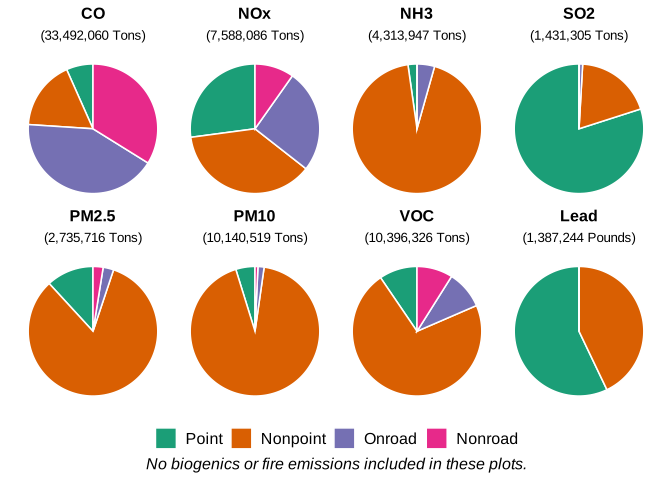
Figure 0.1: Relative contributions of Data Categories to each Criteria Air Pollutant or precursor.
When compared to the 2020 NEI, 2023 wildfire activity in the conterminous United States was low, and this is reflected in the relative contribution of emissions from these sources in the 2023 NEI. In addition, there is wide variability in year-to-year and state-to-state emissions from fires. To reflect this variability, Figure 2 shows total primary PM2.5 and VOC emissions for the top 10 emitting states. 2023 was an active wildfire year in Alaska, resulting in more than 300,000 tons of primary PM2.5 and 1 million tons of VOC. Oregon and California biomass burning emissions were also dominated by wildfires, whereas Florida and Georgia biomass burning emissions are predominantly from prescribed fires.

Figure 0.2: Total PM2.5 and VOC fire emissions for the top 10 emitting states.
Figure 3 shows the top-emitting states by data category for NOx and SO2. In Texas, NOx is led by oil and gas production (294,000 tons), with large contributions from onroad mobile sources (184,000 tons). Texas SO2 is dominated by coal-fired electricity generating units (103,000 tons) with additional emissions from oil and gas production (51,000 tons). In California, NOx is driven by onroad and nonroad mobile sources (167,000 tons), with additional contributions from commercial marine vessels, aircraft, and rail (70,000 tons). Florida’s NOx includes roughly 18,000 tons from natural gas–fired EGUs. For SO2, point-source totals are generally dominated by coal-fired EGUs (e.g., 73,000 tons in Missouri 39,000 tons in Ohio), while New Mexico reflects the influence of oil and gas production (~103,000 tons), highlighting regional sectoral differences. Overall, NOx patterns reflect the combined prominence of mobile sources and oil and gas production, whereas SO2 burdens are concentrated in coal-fired power generation and, in some states, oil and gas production.

Figure 0.3: Total NOx and SO2 emissions, excluding biogenics and fire sources, for the top 10 emitting states.
Figure 4 shows the top-emitting states by data category for VOC and primary PM2.5. In Texas, the dominant source of VOC is oil and gas production (1.4 million tons), with considerable contributions from solvents (250,000 tons). In contrast, primary PM2.5 emissions in Texas is largely derived from construction, road, and agricultural dust (154,000 tons). In California, VOC emissions are led by solvents (199,000 tons) and mobile onroad and nonroad sources (145,000 tons), while primary PM2.5 is driven by construction, road, and agricultural dust (41,000 tons), and residential wood combustion (19,000 tons). New Mexico also exhibits a strong oil and gas signature (348,000 tons). Florida’s VOC emissions are dominated by solvents (179,000 tons) and mobile sources (131,000 tons), with additional contributions from gas stations (26,000 tons). Across other states, PM2.5 burdens are shaped by dust (e.g., (77,000 tons in Kansas) and residential wood combustion (e.g., 29,000 tons in Pennsylvania and 25,000 tons in Ohio).
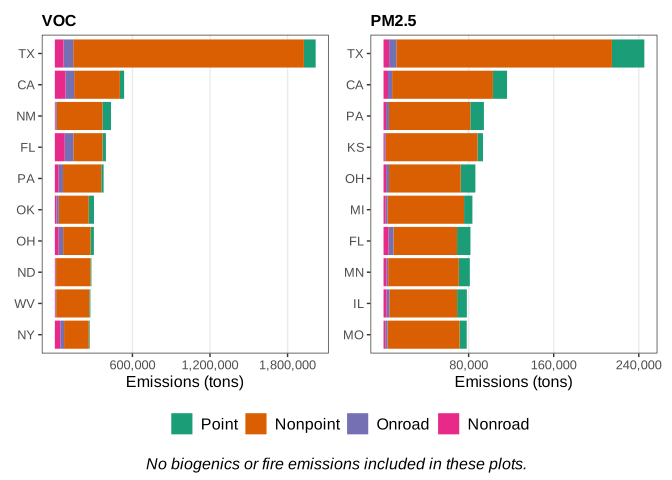
Figure 0.4: Total PM2.5 and VOC emissions, excluding biogenics and fire sources, for the top 10 emitting states.