11.3 EPA-developed estimates
There are three sets of emission estimates that EPA develops for nonpoint Oil and Gas sector contributions to the NEI: Oil and Gas “tool” estimates that were first developed for the 2011 NEI, and new for the 2023 NEI, blowdowns, and abandoned well estimates. Oil and Gas Tool estimates comprise most of the sector’s emissions and are discussed first. Brief subsections detailing blowdowns and abandoned wells are provided later in this section.
The EPA furthered the development of the existing oil and gas emissions estimation tool that was originally developed for the 2011 NEI, which is a MS Access database that uses a bottom-up approach to build a national inventory. More information on the tool can be found in the documentation provided by ERG, entitled “2023 Nonpoint Oil and Gas Emission Estimation Tool” in the file ”2023_Nonpoint_Oil_and_Gas_Emissions_Estimation_Tool.pdf”. There are two modules, as was put in place since the 2014 tool: Exploration and Production. Changes that have been incorporated in the 2023 Oil and Gas Production and Exploration tools since 2020 are addressed in the documentation above. In addition, a memo outlining the additional data from the GHG Reporting Program (subpart W) is entitled 2023 NEI Oil and Gas Tool Subpart W Analysis.
In general, the tool calculates emissions for each piece of equipment on a well pad (like condensate tanks or dehydrators, for example) in a county or basin, based on average equipment counts taken from either surveys, literature searches, or the GHG reporting program, also accounting for control devices and gas composition in each county. County-level details are important, since well pads can vary significantly from region to region, basin to basin, and county to county. A well site in Denver, CO in the Denver-Julesburg Basin might look very different from one in the Marcellus Shale in PA, due to changes in technology over time (when the well was first drilled), geologic formations of the oil and gas reservoirs themselves (which also change over time—the ratio of oil to gas changes as pressure in the reservoir is released), and regulations in place guiding the equipment used on site.
The math used in the oil and gas tool is more complex than most other categories, as it uses equations like the ideal gas law and mass balances, in conjunction with more traditional emission rate equations (activity * EF = emissions); thus, the work is best completed in database format. Overall, there are hundreds of inputs to the oil and gas tool, and these are broken down into three basic categories: activity data, basin factors, and emission factors. These inputs to the tool are filled in by EPA, and published with the tool, along with their references. Region specific inputs are preferable and are used when available. Extrapolated inputs from nearby counties in the same basin are then used to fill in gaps in data. National defaults are filled in where no other data is available, and attempts are made to align inputs as much as possible with the GHG reporting program and emissions inventory.
11.3.1 Activity data
The primary source of activity data for the 2023 Tool is the commercially available database developed by Enverus called HPDI or also called the DI Desktop database. HPDI supplies activity such as number of wells, oil, gas, condensate, and water production, feet drilled, spud counts, and other data. There are cases where this data is not complete, and in those cases, EPA supplemented with data from RIGDATA, from various state oil and gas commissions, and directly from Tool users. More details on these data can be found in the aforementioned report. Table 11.3 shows where Enverus and SLT activity data were used in the 2023 Tool.
| State | Oil/ Associated Gas Production | Natural Gas/ Condensate Production | CBM Gas/ Condensate Production | Produced Water | Well Completions | Spud Counts/ Feet Drilled |
|---|---|---|---|---|---|---|
| Alabama | 2024 ENVERUS | 2024 ENVERUS | 2024 ENVERUS | 2024 ENVERUS | 2024 ENVERUS | 2024 ENVERUS |
| Alaska | 2024 ENVERUS | 2024 ENVERUS | 2024 ENVERUS | 2024 ENVERUS | 2024 ENVERUS | 2024 ENVERUS |
| Alaska | 2024 ENVERUS | 2024 ENVERUS | 2024 ENVERUS | 2024 ENVERUS | AK OGC 2025 | AK OGC 2025 |
| Arizona | AZ OGC 2025 | AZ OGC 2025 | AZ OGC 2025 | AZ OGC 2025 | 2024 ENVERUS | 2024 ENVERUS |
| Arkansas | 2024 ENVERUS | 2024 ENVERUS | 2024 ENVERUS | 2024 ENVERUS | 2024 ENVERUS | 2024 ENVERUS |
| Arkansas | 2024 ENVERUS | 2024 ENVERUS | 2024 ENVERUS | 2024 ENVERUS | 2024 ENVERUS | AR OGC 2025 |
| California | 2024 ENVERUS | 2024 ENVERUS | 2024 ENVERUS | 2024 ENVERUS | 2024 ENVERUS | 2024 ENVERUS |
| California | 2024 ENVERUS | 2024 ENVERUS | 2024 ENVERUS | 2024 ENVERUS | CA OGC 2025 | CA OGC 2025 |
| Colorado | 2024 ENVERUS | 2024 ENVERUS | 2024 ENVERUS | 2024 ENVERUS | 2024 ENVERUS | 2024 ENVERUS |
| Florida | 2024 ENVERUS | 2024 ENVERUS | 2024 ENVERUS | 2024 ENVERUS | 2024 ENVERUS | 2024 ENVERUS |
| Idaho | ID OGC 2025 | ID OGC 2024 | ID OGC 2024 | ID OGC 2024 | 2024 ENVERUS | 2024 ENVERUS |
| Illinois | IPRB 2025 | EIA 2025 | EIA 2025 | CALC_RATIO | 2024 ENVERUS | 2024 ENVERUS |
| Illinois | IPRB 2025 | IL OGC 2024 | IL OGC 2024 | CALC_RATIO | IL OGC 2024 | IL OGC 2025 |
| Indiana | EIA 2025 | EIA 2025 | EIA 2025 | CALC_RATIO | 2024 ENVERUS | 2024 ENVERUS |
| Indiana | IN OGC 2024 | IN OGC 2024 | IN OGC 2024 | CALC_RATIO | IN OGC 2025 | IN OGC 2025 |
| Kansas | 2024 ENVERUS | 2024 ENVERUS | 2024 ENVERUS | 2024 ENVERUS | 2024 ENVERUS | 2024 ENVERUS |
| Kansas | KS DHE 2025 | KS DHE 2025 | KS DHE 2025 | KS DHE 2025 | KS OGC 2025 | KS DHE 2025 |
| Kentucky | EIA 2025 | EIA 2025 | EIA 2025 | CALC_RATIO | 2024 ENVERUS | 2024 ENVERUS |
| Kentucky | KY GS 2024 | KY GS 2024 | KY GS 2024 | CALC_RATIO | KY DEP 2025 | KY OGC 2025 |
| Louisiana | 2024 ENVERUS | 2024 ENVERUS | 2024 ENVERUS | 2024 ENVERUS | 2024 ENVERUS | 2024 ENVERUS |
| Louisiana | 2024 ENVERUS | 2024 ENVERUS | 2024 ENVERUS | CALC_RATIO | 2024 ENVERUS | 2024 ENVERUS |
| Maryland | EIA 2025 | EIA 2025 | EIA 2025 | 2024 ENVERUS | 2024 ENVERUS | 2024 ENVERUS |
| Michigan | 2024 ENVERUS | 2024 ENVERUS | 2024 ENVERUS | MI EGLE 2024 | 2024 ENVERUS | 2024 ENVERUS |
| Michigan | MI EGLE 2024 | MI EGLE 2024 | MI EGLE 2024 | MI EGLE 2024 | 2024 ENVERUS | 2024 ENVERUS |
| Mississippi | 2024 ENVERUS | 2024 ENVERUS | 2024 ENVERUS | MS OGC 2025 | 2024 ENVERUS | 2024 ENVERUS |
| Missouri | MO DNR 2025 | MO DNR 2025 | MO DNR 2025 | MO DNR 2025 | 2024 ENVERUS | 2024 ENVERUS |
| Missouri | MO DNR 2025 | MO DNR 2025 | MO DNR 2025 | CALC_RATIO | MO DNR 2025 | MO DNR 2025 |
| Montana | 2024 ENVERUS | 2024 ENVERUS | 2024 ENVERUS | 2024 ENVERUS | 2024 ENVERUS | 2024 ENVERUS |
| Nebraska | 2024 ENVERUS | 2024 ENVERUS | 2024 ENVERUS | 2024 ENVERUS | 2024 ENVERUS | NE OGC 2024 |
| Nebraska | NE OGC 2025 | 2024 ENVERUS | 2024 ENVERUS | 2024 ENVERUS | 2024 ENVERUS | RIGDATA |
| Nevada | 2024 ENVERUS | 2024 ENVERUS | 2024 ENVERUS | 2024 ENVERUS | 2024 ENVERUS | 2024 ENVERUS |
| Nevada | NV DEP 2025 | NV DEP 2025 | NV DEP 2025 | NV DEP 2025 | 2024 ENVERUS | 2024 ENVERUS |
| New Mexico | 2024 ENVERUS | 2024 ENVERUS | 2024 ENVERUS | 2024 ENVERUS | 2024 ENVERUS | 2024 ENVERUS |
| New York | 2024 ENVERUS | 2024 ENVERUS | 2024 ENVERUS | 2024 ENVERUS | 2024 ENVERUS | 2024 ENVERUS |
| New York | 2024 ENVERUS | 2024 ENVERUS | 2024 ENVERUS | 2024 ENVERUS | 2024 ENVERUS | NY OGC 2025 |
| North Dakota | 2024 ENVERUS | 2024 ENVERUS | 2024 ENVERUS | 2024 ENVERUS | 2024 ENVERUS | 2024 ENVERUS |
| Ohio | 2024 ENVERUS | 2024 ENVERUS | 2024 ENVERUS | 2024 ENVERUS | 2024 ENVERUS | 2024 ENVERUS |
| Oklahoma | 2024 ENVERUS | 2024 ENVERUS | 2024 ENVERUS | CALC_RATIO | 2024 ENVERUS | 2024 ENVERUS |
| Oregon | 2024 ENVERUS | 2024 ENVERUS | 2024 ENVERUS | 2024 ENVERUS | 2024 ENVERUS | 2024 ENVERUS |
| Pennsylvania | 2024 ENVERUS | 2024 ENVERUS | 2024 ENVERUS | PA DEP 2025 | 2024 ENVERUS | 2024 ENVERUS |
| South Dakota | 2024 ENVERUS | 2024 ENVERUS | 2024 ENVERUS | 2024 ENVERUS | 2024 ENVERUS | 2024 ENVERUS |
| South Dakota | 2024 ENVERUS | 2024 ENVERUS | 2024 ENVERUS | 2024 ENVERUS | 2024 ENVERUS | SD OGC 2025 |
| Tennessee | EIA 2025 | EIA 2025 | EIA 2025 | CALC_RATIO | 2024 ENVERUS | 2024 ENVERUS |
| Tennessee | TN OGC 2025 | TN OGC 2025 | TN OGC 2025 | CALC_RATIO | 2024 ENVERUS | 2024 ENVERUS |
| Texas | TCEQ 2025 | TCEQ 2025 | 2024 ENVERUS | 2024 ENVERUS | 2024 ENVERUS | 2024 ENVERUS |
| Texas | TCEQ 2025 | TCEQ 2025 | 2024 ENVERUS | 2024 ENVERUS | TX RRC 2025 | TX RRC 2025 |
| Utah | 2024 ENVERUS | 2024 ENVERUS | 2024 ENVERUS | 2024 ENVERUS | 2024 ENVERUS | 2024 ENVERUS |
| Virginia | 2024 ENVERUS | 2024 ENVERUS | 2024 ENVERUS | 2024 ENVERUS | 2024 ENVERUS | 2021 ENVERUS |
| Virginia | 2024 ENVERUS | 2024 ENVERUS | 2024 ENVERUS | 2024 ENVERUS | 2024 ENVERUS | VA OGC 2024 |
| West Virginia | 2024 ENVERUS | 2024 ENVERUS | 2024 ENVERUS | 2024 ENVERUS | 2024 ENVERUS | WVDEP 2024 |
| Wyoming | 2024 ENVERUS | 2024 ENVERUS | 2024 ENVERUS | 2024 ENVERUS | 2024 ENVERUS | 2024 ENVERUS |
11.3.2 Temperature data
Annual average temperature at 2-meters above the ground data by county is needed by the Oil and Gas Tool to compute Loading Emissions from production activities. As shown in Figure 11.1, year 2023 meteorology data from the Weather Research and Forecasting (WRF) model version 4.4.2 (WRFv4.4.2) was used to calculate an annual average 2-meter temperature in degrees Fahrenheit at the county level.
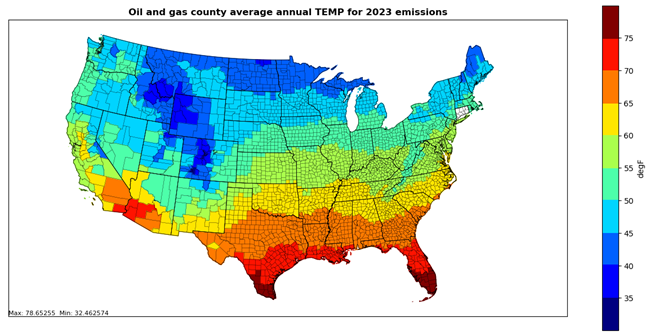
Figure 11.1: County, annual average temperatures at 2-meters above ground for year 2023
11.3.3 Basin factors
Basin factors include factors that are secondary to activity and include assumptions about equipment counts on a per well basis, (e.g., the number of pneumatic controllers per well, or the average HP of an engine at a well site) as well as gas speciation profiles (fraction of benzene, toluene, xylene, or ethylbenzene in natural gas at a particular point in the well pad, e.g., post separator).
For 2023 inputs, GHGRP data gathered under subpart W was analyzed to develop updated basin factors for several source categories including storage tanks, dehydrators, fugitive equipment leaks, heaters, pneumatic devices, and wellhead compressor engines. See “2023 NEI Tool Subpart W Data Analysis” memo dated April 15, 2025. Attachments to this memo are located on the 2023 NEI Supplemental FTP site.
Other basin factor updates for the 2023 Oil and Gas Tool included the following:
- California Air Resources Board provided fraction of gas vented updates for eight counties in California.
- North Dakota DEP provided condensate tank and crude oil tank flare capture efficiency updates.
- Utah DEQ provided condensate tank and crude oil tank flare capture efficiency updates, as well as CBM basin factor updates.
- Pennsylvania DEP provided mug degassing, well completion, fugitives, liquids unloading, and pneumatic device gas composition profile updates.
- Texas Commissions on Environmental Quality (TCEQ) provided well completion, loading, and liquids unloading basin factor updates.
- US Energy Information Administration (EIA) data was used to update the volumes of gas vented/flared in the associated gas venting and flaring category.
11.3.4 Emission Factors
Emission factors are also a part of the formula for estimating emissions, and in the Oil and Gas tool the nomenclature is set such that we only call the standard national factors, like from AP-42 combustion equations, “emission factors.” For the 2023 Tool, the only emissions factor update was for drilling and hydraulic fracturing engine emission factors were updated using the MOVES version 5 model for 2023.
11.3.5 Point source subtractin
Some states count upstream oil and gas production processes as point sources and therefore have a need to subtract these from the nonpoint part of the inventory. The tool allows for point source subtraction on either an activity or emissions basis, and a few states have taken advantage of this feature.
The state of New Mexico added a considerable number of sources to their oil and gas point source inventory in the NEI. New Mexico provided a county-SCC summary of emissions for use in the Tool as part of the point source subtraction functionality. Updated nonpoint emissions were generated for New Mexico after this point source subtraction and were used in the 2023NEI. This same process was done for the state of Kansas as well.
11.3.6 Other State-specific correspondence
Oklahoma
The Oklahoma Department of Environmental Quality (OK DEQ) uses a mix of both EPA estimates (for the exploration module) and their own emissions using the oil and gas tool (production module only). OK DEQ allows EPA to do HAP augmentation for the SCCs that they submit. One difference between OK DEQ’s SCC emissions dataset and EPA’s SCCs is that OK DEQ aggregates their equipment-specific fugitive emissions into Fugitive All Process SCCs for oil, gas and CBM wells.
Pennsylvania
The PADEP relies on EPA to run the oil and gas tool but utilizes alternative SCCs for several source categories to differentiate their emissions for conventional and unconventional oil and gas operations. PA DEP provides unconventional well API numbers which EPA then subtracts from the tool to determine the conventional portion. The process includes the following steps:
- Run the tool with basin factors that the Mid-Atlantic Regional Air Management Association (MARAMA) provided for the 2014 NEI oil and gas sector for:
- Artificial lifts
- Associated gas
- Condensate tanks
- Crude tanks
- Dehydrators
- Fugitives
- Gas-actuated pumps (oil and gas wells)
- For associated gas, condensate tanks, crude oil tanks, and dehydrators, if the Tool sources were the 2023 GHGRP factors recently documented, these were not replaced. EPA also incorporated gas composition profiles provided by the PA DEP.
- Remove the activity data related to the emissions data provided by PA using API numbers for unconventional wells.
- Run the tool for adjusted emissions.
- Use the “conventional only” SCCs to replace the more “general” Tool SCCs for 5 source categories:
- Drilling
- Gas Well Condensate Tanks
- Gas Well Heaters
- Gas Well Dehydrators
- Gas Well Liquids Unloading
Details regarding the Pennsylvania emissions can be found in the workbook “PA_2023_EMISSIONS_20250610.xlsx” on the 2023 NEI Supplemental FTP site.
11.3.7 Emissions estimates outside of the Oil and Gas Tool: Blowdowns
Blowdown/pigging emissions were reported to EPA for year 2023 for the following activities for these four industry segments:
- All other equipment with a physical volume greater than or equal 50 ft^3
- Compressors
- Emergency shutdowns
- Facility piping
- Pig launchers and receivers
- Pipeline venting
- Scrubbers/strainers
VOC and HAP-VOC emissions were estimated outside of the Oil and Gas Tool and summed to the county level for year 2023 and assigned the SCC 2310021801 (Pipeline Blowdowns and Pigging). The national total for VOC emissions from these sources was around 22,000 tons in 2023. A technical memo “2023 NEI Oil and Gas Tool GHGRP Blowdown Emissions.docx” on the 2023 NEI Supplemental FTP site highlights the methodology used and the resulting emissions estimates for this source.
11.3.8 Emissions estimates outside of the Oil and Gas Tool: Abandoned Wells
A new source to the 2023NEI is abandoned wells. In the oil and gas industry, there are a growing number of wells that, with the passage of time, have lost their productivity, and may have been abandoned, deactivated, or neglected. Because of this lack of oversight, these wells may continue to leak methane, CO2, VOC, and various HAPs. The term “abandoned wells” encompasses various types of oil and gas wells, including orphaned wells and other non-producing wells:
- Wells with no recent production and not plugged. Common terms (such as those used in state databases) might include inactive, temporarily abandoned, shut-in, dormant, and idle.
- Wells with no recent production and no responsible operator. Common terms might include orphaned, deserted, long-term idle, and abandoned.
- Wells that have been plugged to prevent migration of gas or fluids.
As of year 2022, [ref 1] based on the 2018 Inventory of U.S. Greenhouse Gas Emissions and Sinks (GHGI) there are approximately 3.9 million abandoned wells in the U.S., with around 3.0 million abandoned oil wells and 0.9 million abandoned gas wells. The GHGI methodology and estimates of emissions from abandoned wells serve as the starting point for development of the VOC and HAP emissions inventory for abandoned wells discussed here.
All active SCCs for abandoned wells were newly created in 2022 and are listed in Table 11.4. The SCC level 1 and 2 descriptions are “Industrial Oil and Gas Exploration and Production” for all SCCs. The column titled “EPA” denotes which SCCs are estimated in the NEI.
| SCC | SCC level three | SCC level four | EPA |
|---|---|---|---|
| 2310023700 | Coal Bed Methane Natural Gas | Abandoned Well: Plugged and Unplugged | – |
| 2310023701 | Coal Bed Methane Natural Gas | Abandoned Well: Plugged | – |
| 2310023702 | Coal Bed Methane Natural Gas | Abandoned Well: Unplugged | – |
| 2310111800 | On-Shore Oil Exploration | Abandoned Well: Plugged and Unplugged | – |
| 2310111801 | On-Shore Oil Exploration | Abandoned Well: Plugged | Y |
| 2310111802 | On-Shore Oil Exploration | Abandoned Well: Unplugged | Y |
| 2310121800 | On-Shore Gas Exploration | Abandoned Well: Plugged and Unplugged | – |
| 2310121801 | On-Shore Gas Exploration | Abandoned Well: Plugged | Y |
| 2310121802 | On-Shore Gas Exploration | Abandoned Well: Unplugged | Y |
11.3.8.1 Overview of Calculations
VOC and HAP emissions from abandoned wells are calculated as follows: Step 1. Develop county-level populations of plugged and unplugged abandoned oil, gas, and dry wells using the Enverus and historical 1975 abandoned well datasets.
Step 2. Multiply the county-level abandoned well counts by the CH4 emission factors.
Step 3. Apply the CH4 to VOC and CH4 to BTEX pollutant ratios from EPA’s Nonpoint Oil and Gas Emission Estimation Tool. Gas well speciation is currently used to estimate emissions from “dry wells” as categorized in the Enverus dataset.
11.3.8.2 Activity Data
EPA plans to utilize the GHGI released annually to estimate the number of abandoned wells. This index of abandoned wells used in this methodology is available in the workbook “2024_ghgi_abandoned_wells_annex_tables.xlsx” on the 2023 NEI Supplemental FTP site.
The GHG inventory (GHGI) initially provided activity estimates for abandoned wells and primarily depended upon the Enverus database. However, there are a portion of the abandoned wells which are not included in the Enverus dataset. To account for very old wells with installation and abandonment predating Enverus database coverage, EPA developed an independent estimate of abandoned wells existing prior to 1975. References reviewed to develop the number of abandoned wells not included in the Enverus dataset include historical records collected by state agencies and by USGS. This is outlined in the 2018 Abandoned Wells memo and includes sources like The Derrick’s Handbook of Petroleum and the USGS Mineral Resources of the US Annual Yearbooks. EPA estimated that about 1 million abandoned wells are not captured in the Enverus based methodology. See the 2018 Abandoned Wells Memo [ref 2] for additional information on how the value was calculated for each state.
The state level historical pre-1975 abandoned well estimates are presented in Table 11.5, and all are assumed to be unplugged.
| State | Abandoned Oil Well Count | Abandoned Gas Well Count |
|---|---|---|
| AR | 12534 | 1356 |
| CA | 32621 | 1005 |
| FL | 165 | 0 |
| IL | 82914 | 1565 |
| IN | 37391 | 13558 |
| KS | 8554 | 1562 |
| KY | 25982 | 5094 |
| LA | 19900 | 4620 |
| MS | 8040 | 601 |
| M | 466 | 103 |
| NM | 2110 | 868 |
| OH | 53732 | 12984 |
| OK | 2386 | 275 |
| PA | 250077 | 42453 |
| TX | 461851 | 82267 |
| WV | 2419 | 2684 |
| Total | 880837 | 155872 |
11.3.8.3 Allocation Procedure
To develop a complete estimate of abandoned wells, the 1975 historical abandoned well counts were added to the counts of abandoned wells from Enverus. However, only state totals are available for this historical data. Therefore, the state-level abandoned well counts presented in Table 11.5 were disaggregated to the county level. For all states but IL and IN, the historical 1975 state level abandoned oil and gas well counts were disaggregated to the county level using Enverus ratios of abandoned oil and gas wells in each county. Enverus only identified one abandoned well in IL and IN, which was insufficient to employ the same disaggregation methodology used for the rest of the U.S. Therefore, the historical 1975 state level abandoned oil and gas well counts for IL and IN were disaggregated to the county level using ratios of producing oil and gas wells in each county from EPA’s Nonpoint Oil and Gas Emission Estimation Tool.
11.3.8.4 Emissions Factors
Based on a review of existing literature and studies, region-specific emission factors (EFs) for plugged and unplugged abandoned wells were developed under the GHGI. Wells that are plugged have much lower average emissions than wells that are unplugged, with around 40 percent of abandoned wells in the U.S. being plugged. The fraction of abandoned wells that are plugged has increased over time as more wells fall under regulations and programs requiring or promoting plugging of abandoned wells. As a result of this literature review, two sets of CH4 emission factors were developed – one set for the Appalachia region and one set for the rest of the U.S. Each set of emission factors contains one factor for plugged wells, and one factor for unplugged wells. Table 11.6 provides the two sets of CH4 emission factors used in the GHGI. The Appalachia basin includes the states of KY, NY, OH, PA, TN, and WV.
| Well Category | EF (g CH4/h/well) |
|---|---|
| Plugged wells (non-Appalachia) | 0.002 |
| Unplugged wells (non-Appalachia) | 10.020 |
| Plugged wells (Appalachia) | 0.357 |
| Unplugged wells (Appalachia) | 30.570 |
Methane (CH4) emission factors for abandoned wells used in the GHGI are then used to calculate VOC and HAP emission estimates, using ratios. This information is available in EPA’s Nonpoint Oil and Gas Emission Estimation Tool for several source categories for VOC and the HAPs Benzene, Toluene, Ethylbenzene, and Xylenes (BTEX). However, no speciation data specific to abandoned well emissions were available. Therefore, speciation data for oil and gas well completions were used as a surrogate to estimate VOC and BTEX emissions.
Table 11.7 provides an example of the speciation data used to estimate VOC and HAP emissions based on CH4 emissions from gas wells in select counties in Pennsylvania.
| STATE COUNTY FIPS | STATE ABBR | COUNTY NAME | Gas Well VOC:CH4 | Gas Well Benzene:CH4 | Gas Well Ethylbenzene:CH4 | Gas Well Toluene:CH4 | Gas Well Xylene:CH4 |
|---|---|---|---|---|---|---|---|
| 42001 | PA | Adams | 0.0102 | 0.000198 | 0.0000060 | 0.000172 | 0.0000522 |
| 42003 | PA | Allegheny | 0.0102 | 0.000198 | 0.0000060 | 0.000172 | 0.0000522 |
| 42005 | PA | Armstrong | 0.0127 | 0.000212 | 0.0000064 | 0.000184 | 0.0000558 |
| 42007 | PA | Beaver | 0.0953 | 0.000233 | 0.0000070 | 0.000203 | 0.0000615 |
Appendix A in the 2018 Abandoned Wells Memo [ref 2] contains the complete set of speciation data used to estimate VOC and HAP emissions for each county and well type.
11.3.8.6 Emissions
Emissions from abandoned wells are calculated by multiplying the number of wells in each SCC in each county by well-type (oil or gas) and plugged/unplugged status-specific CH4 emissions factors from Table 11.6, and then by the ratio of pollutant to methane.
\[\begin{equation} E_{c,SCC,i} = AB_{c,SCC} \times EF_{SCC,CH4,c,w,pl} \times R_{p,SCC,c} \tag{11.1} \end{equation}\]
Where:
\(E_{c,SCC,i}\) = Emissions of pollutant i from each SCC in county c
\(AB_{c,SCC}\) = Abandoned well count (by well type and plugged status) in each SCC in county c
\(EF_{SCC,CH4,c,w,pl}\) = CH4 emissions factor for each SCC based on county c, well type w, and plugged status pl
\(R_{p,SCC,c}\) = Pollutant p to CH4 ratio for each SCC (based on location and well type) in county c
11.3.8.7 Point Soutce Subtraction
There are no point source-specific SCCs for abandoned wells; therefore, point source subtraction is not performed for this category.
11.3.8.8 Sample Calculations
Table 11.8 lists sample calculations for the estimation of emissions of VOC from unplugged gas wells in Allegheny County, Pennsylvania.
| Eq. # | Equation | Values | Result |
|---|---|---|---|
| 1 | \(E_{c,SCC,i} = AB_{c,SCC} \times EF_{SCC,CH4,c,w,pl} \times R_{p,SCC,c}\) | 760 unplugged gas wells x 30.573 (g CH4/hr/well) x 0.0102 (lb VOC/lb CH4) | 237.15 g/hr VOC |
| 2 | Units Converstion | (8760/453.592/2000 units conversion) | 2.29 tpy VOC |